


Breadcrumb
Gerontology Program
Coming in fall 2027:
- Certificate of Study in Gerontology
- Advanced Certificate of Study in Gerontology Leadership
These two online certificate programs are pending approval by the university's Integrated Curriculum Committee.
Coming in fall 2029:
- Bachelor of Professional Studies in Gerontology
This online degree completion program is pending approval by the California State University Chancellor's Office and the university's Integrated Curriculum Committee.
NOTE: Program names, requirements, and availability are subject to change.
Gerontology at Cal Poly Humboldt
Every community is shaped by the people who have grown older in it. They raised families, kept businesses open, served on volunteer fire crews and school boards, and carried their towns through difficult years. As they age, most of them want what any of us would want: to stay close to home, to be known by the people around them, and to have a say in their own care.
The Gerontology program at Cal Poly Humboldt prepares people to help make that possible. It is a fully online program for students who live and work in rural places, and for those who care about them. You do not need to leave your community to study. Your community becomes part of your coursework. In every course, you will spend time with older adults, families, or service providers where you live, and bring what you learn back into your studies.
Many students come to this work because of someone they love. Some are caring for a parent or grandparent. Some have worked for years in home care, senior services, or health care and are ready for the knowledge and credential to grow in that work. Some are just beginning and know they want their work to matter to the people around them.
Whatever brings you here, your experience belongs in this program, and we will build on it with you.
What is gerontology?
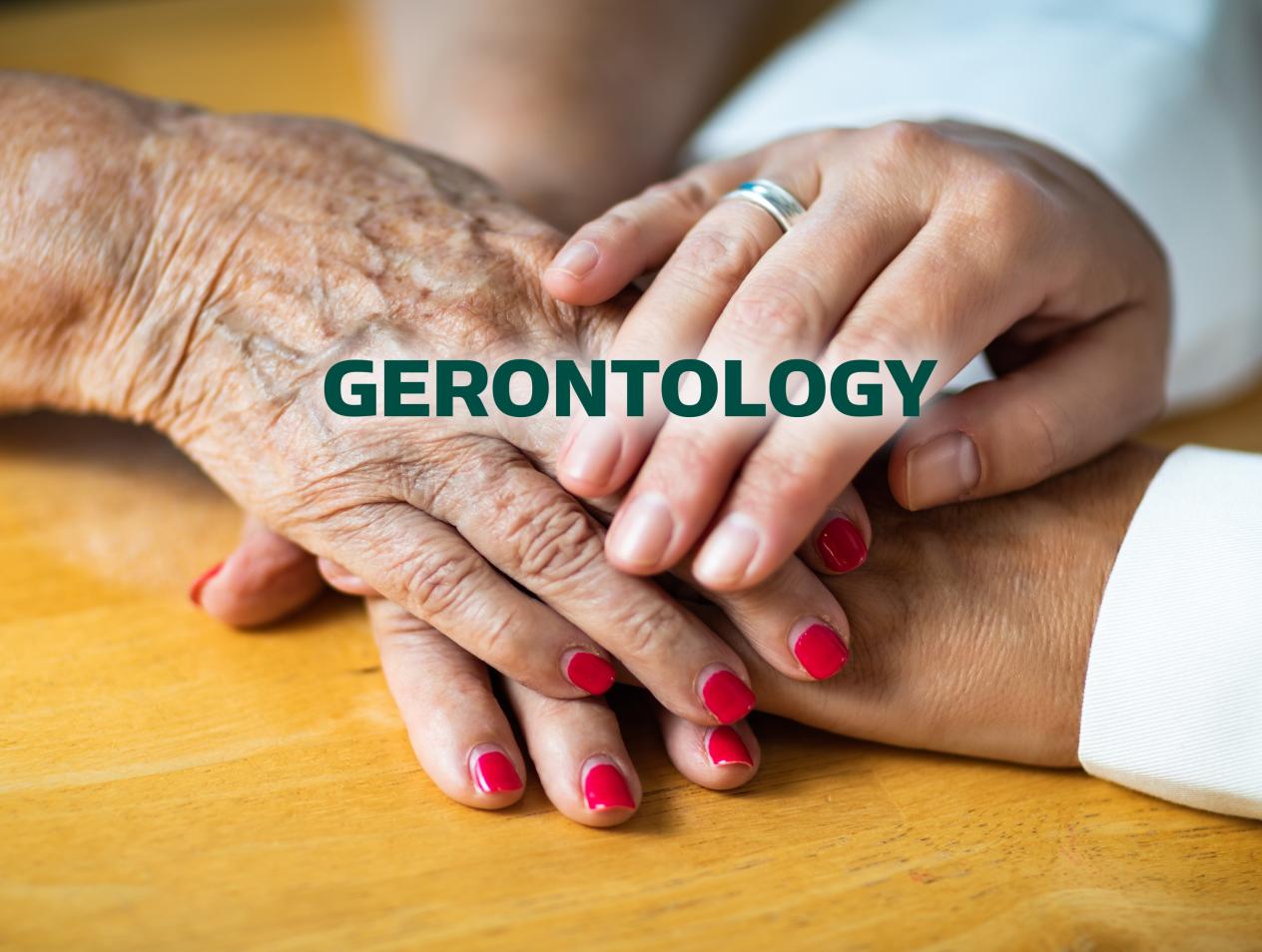
Gerontology is the study of aging across the whole of a person's life. It looks at the body and the mind, at relationships and family, and at the communities and systems that support people as they grow older. It draws from psychology, biology, sociology, public health, social work, the humanities, and public policy.
Gerontologists work wherever older adults and their families are: in senior centers and adult day programs, home and community-based care, health systems, hospice, housing, advocacy organizations, and county and tribal aging services.
The field asks a hopeful question: what would it take for people to age well, with dignity, in the places they call home?

Why this work matters now
California is growing older. By 2040, 22 percent of Californians will be 65 or older, up from 14 percent in 2020 (Public Policy Institute of California, 2025). The change is especially significant in rural areas. By 2040, the number of rural Californians aged 85 and older is projected to grow by 158 percent (The SCAN Foundation, 2025). These are the elders who often need the most support, and they live in the communities with the fewest trained professionals.
Rural aging services often operate with small staffs covering long distances. Families fill many of the gaps themselves, frequently without training, relief, or recognition. California's Master Plan for Aging calls for building an aging services workforce that is well trained and present in every part of the state. This program was created to help prepare that workforce — one student and one community at a time.
Why Humboldt
Cal Poly Humboldt is a rural university, and the program faculty know what it means to serve people across long distances with limited resources. In this program, rural aging is the thread that runs through every course. You will study the realities that shape aging outside of cities: distance to care, gaps in services, workforce shortages, transportation and broadband access, and the county, state, and tribal jurisdictions that rural services must work across.
These courses were developed by Cal Poly Humboldt faculty from psychology, kinesiology, the humanities, and social work, and they are aligned with the competencies of the Academy for Gerontology in Higher Education. What you learn is meant to be used where you live, whether your community is a coastal town, a farming valley, a mountain county, or a place far from the nearest city.
How the program works
Fully online and asynchronous. There are no required log-in times. You complete your work on a weekly schedule that fits around your job, family, and caregiving responsibilities.
Eight-week courses, one at a time. Each course is 3 units and runs for eight weeks. Students take one course per session, two in the fall and two in the spring, so you can give each course your full attention.
Community engagement in every course. Each course includes a signature assignment that connects you with older adults, service providers, or community organizations where you live.
Credentials that build on each other. The 12-unit Certificate in Gerontology can be completed in one academic year. Those units apply in full toward the 24-unit Advanced Certificate in Gerontology Leadership, and all 24 units apply toward the planned Bachelor of Professional Studies in Gerontology.
Open to degree-seeking and non-degree-seeking students. You can earn a certificate on its own, or use it as a step toward a degree.
Program launch
The Certificate in Gerontology and the Advanced Certificate in Gerontology Leadership are planned to launch in fall 2027, pending approval by the university's Integrated Curriculum Committee.
The Bachelor of Professional Studies in Gerontology is planned to launch in fall 2029, pending approval by the California State University Chancellor's Office and the university's Integrated Curriculum Committee.
What you will be able to do
Students who complete the program will be prepared to:
- Understand aging as a whole-person experience, drawing on biological, psychological, social, and cultural perspectives.
- Recognize the inequities facing rural older adults and advocate for practical solutions in policy and programs.
- Communicate clearly and professionally, in writing and in person, with older adults, families, providers, and decision makers.
- Find, evaluate, and apply reliable information to real situations in aging practice.
- Work alongside others across agencies and communities to plan and improve services for older adults.
- Practice with integrity and respect, honoring the cultures, choices, and histories of the older adults and communities you serve.
Frequently Asked Questions: Gerontology
No. The program begins with GERO 301, Foundations in Rural Gerontology, which introduces the field and builds the knowledge you need for the courses that follow. If you already work with older adults, your experience will enrich your coursework and the learning of your classmates.
No. Courses are fully asynchronous. You will have weekly deadlines, but you decide when during the week to read, write, and participate.
Taking one course per session, you can complete the Certificate of Study in Gerontology in one academic year and the Advanced Certificate of Study in Gerontology Leadership in two academic years. Or take two courses per session and finish both certificates in one academic year.
Each eight-week course covers the work of a full-semester course in half the time, so plan for a steady weekly commitment. Each course has weekly deadlines and takes about 15-18 hours a week.
Yes. But this program is only for residents of the State of California. State and federal laws require colleges and universities to obtain authorization for distance education instruction or programs provided in states other than their own. Cal Poly Humboldt is currently not authorized to offer online instruction or degree programs to students residing outside of California.
In each course, you will complete a signature assignment that involves real people in your community. You might interview an older neighbor about their life, walk a main street to assess how well it supports aging, or talk with local providers about unmet needs.
In the certificate courses, you arrange these contacts yourself, using guides and consent forms provided by the program. Certificate of Study in Gerontology students document 60 hours of community engagement. Advanced Certificate of Study in Gerontology Leadership students document 230 hours, including a supervised practicum.
Yes, if you continue. Units earned in the Certificate of Study in Gerontology apply in full toward the Advanced Certificate of Study in Gerontology Leadership, and all 24 units of the Advanced Certificate of Study in Gerontology Leadership apply toward the planned Bachelor of Professional Studies in Gerontology. The degree is planned for fall 2029, pending approval.
You may be able to. Credit for prior learning recognizes the knowledge and skills you have built through substantial professional experience with older adults. It applies to the practicum hours in the Advanced Certificate in Gerontology Leadership.
To be considered, you apply through the Gerontology program and submit a portfolio documenting your experience. If you are approved, you enroll in a 1-unit administrative course while faculty review your portfolio. You do not enroll in GERO 455S, the Professional Practicum in Gerontology.
Credit for prior learning does not replace other coursework. You will still complete GERO 301, 305, 311W, and 321.
If you think your experience may qualify, talk with an advisor before you plan your courses. Contact us at gero@humboldt.edu.
It depends on which program you're pursuing.
Certificates: Financial aid for the Certificate of Study in Gerontology and the Advanced Certificate of Study in Gerontology Leadership is limited to student loans. Grants, such as Pell or Cal Grant, are not available for the certificates.
Bachelor's degree: The Bachelor of Professional Studies in Gerontology is eligible for financial aid, including grants and loans, once it's approved by the CSU Chancellor's Office. To apply, file the FAFSA or the California Dream Act Application.
Other ways to pay: You pay by the course, so you can spread the cost out over time. Many healthcare and human services employers help with tuition. Veterans and their dependents can ask about using VA education benefits. And if you have experience in aging services, credit for prior learning may lower your total units.
Questions about your situation? Contact the Financial Aid Office and we'll help you sort through your options.